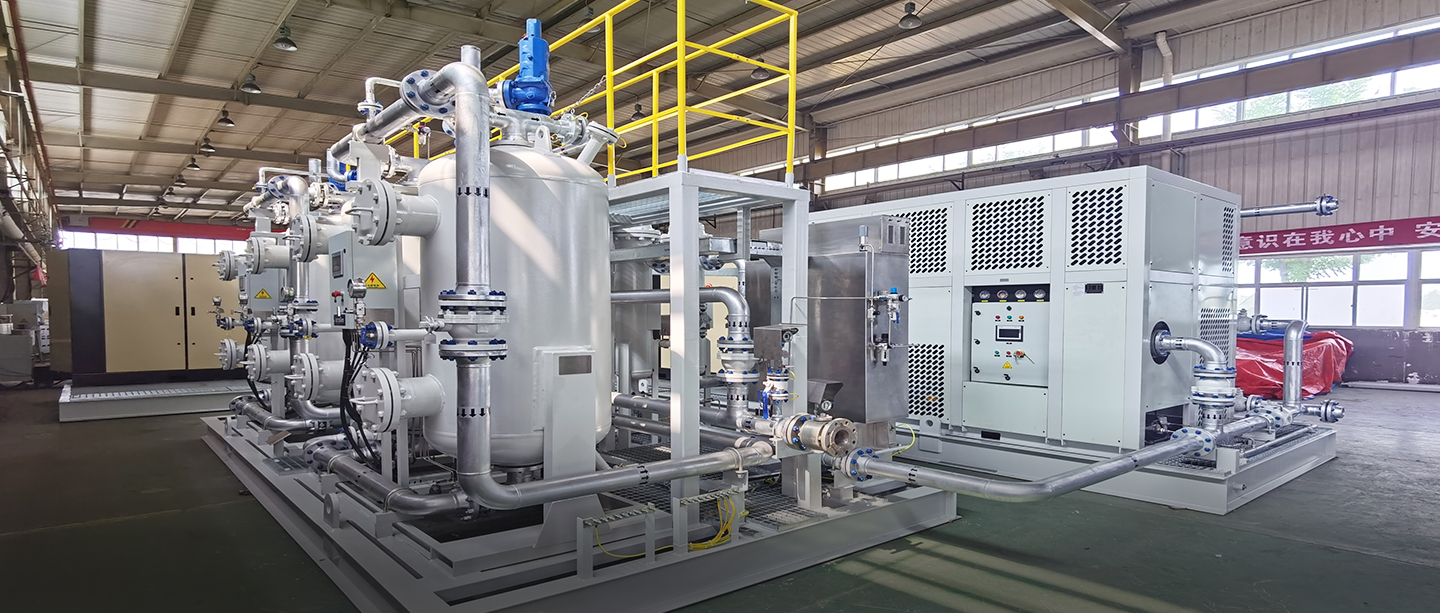
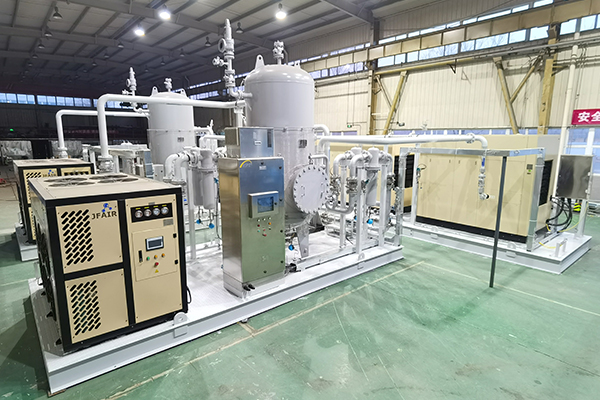
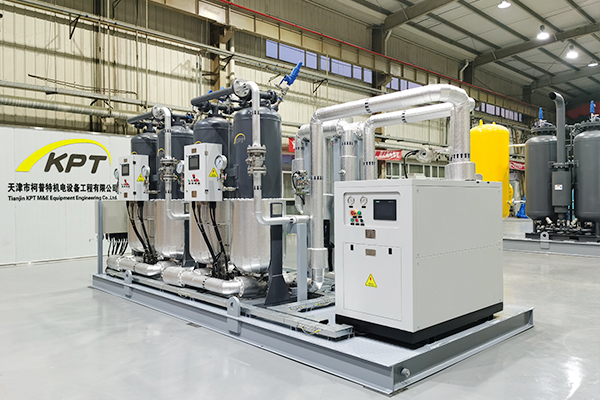
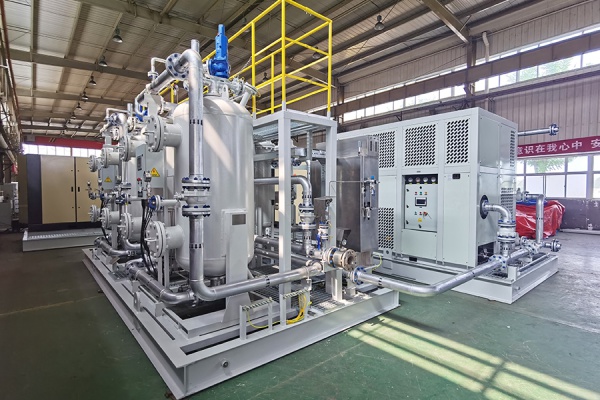
Dryer Module
Introduction to gas dryers:
1. Introduction to Main Types
Refrigerated dryer
Principle: The compressed air temperature is lowered through a refrigeration cycle, causing moisture to condense into a liquid state before being discharged.
Features: Low energy consumption, suitable for handling large volumes of air, but the dew point is limited by ambient temperature (typically <2℃).
Adsorption dryer
Principle: Adsorbents (such as activated alumina and molecular sieves) adsorb moisture, and the adsorbents are regenerated by pressure or temperature changes.
Features: Dew point can reach below -40℃, suitable for high-precision drying needs.
expansion dryer
Principle: It utilizes the gas's own expansion (Joule-Thomson effect) for refrigeration, without the need for external refrigerant.
Applicable scenarios: Small-scale natural gas or special gas processing.
2. Technical parameters
Processing flow rate: 0.1~200㎡/min
Dew point range: -40~-70℃
3. Application Industries
Chemical industry: Drying organic solvents (such as ethanol and acetone) requires explosion-proof design.
Pharmaceuticals: Raw material drying in a sterile environment must comply with GMP standards.
Food: Avoid metal contamination; materials must be food-grade (such as 316L stainless steel).
Gas dryers achieve gas dehydration through freezing, adsorption, or expansion technologies. Selection must be based on process requirements and safety standards. Future trends indicate a move towards intelligent control (such as AI-based regeneration cycle adjustment) and low-carbon technologies (cold energy recovery).
Contact Information
E-mail:kpt@vip.163.com
Sales Department:
International Markets:
Name: Zhang Ning
E-mail:zhangning@cnkpt.com
Telephone:+86 15122363326
WhatsApp:+86 15122363326
Skype :live:.cid.8ce260f7adff31dd
China Market:
Name: Guo Le
E-mail:guole@cnkpt.com
Telephone:+86 15122381880
After-sales service department:
Name: Liu Gang
E-mail:liugang@cnkpt.com
Telephone:+86 15022544922
Name: Han Jianping
E-mail:hanjianping@cnkpt.com
Telephone:+86 18526288340
International Engineering:
Name: Xue Xiulong
E-mail:xuexiulong@cnkpt.com
Telephone:+86 13672109867
Name: Yao Jingxuan
E-mail:yaojingxuan@cnkpt.com
Telephone:+86 13920277001
Share Us

Site Navigation
Copyright © 2025 All Rights Reserved
Tianjin Kepu Electromechanical Equipment Engineering Co., Ltd.
All rights Reserved|Technical Support:YunChuangChengda This Site Supports IPv6
Please choose online customer service to communicate


 中文
中文
 English
 SaudiArabia