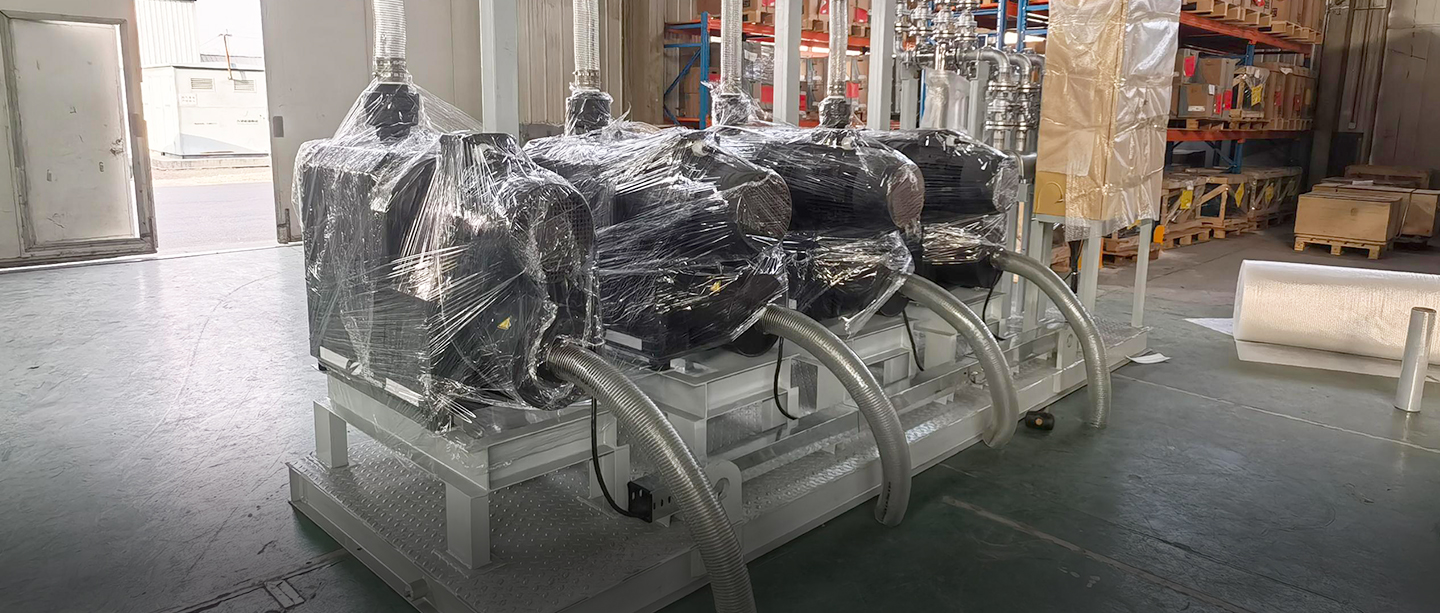
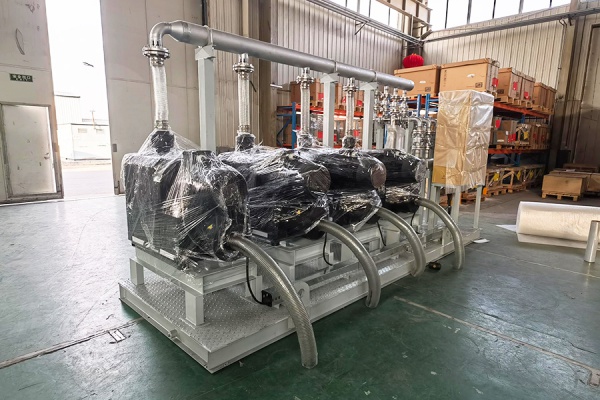
Vacuum Pump System
A vacuum pump system is a pumping device consisting of two or more vacuum pumps and auxiliary equipment, which work together to achieve a specific vacuum level requirement. Its core design is based on the selection of the main pump, which needs to be matched according to parameters such as ultimate pressure, gas composition, and pumping speed. For example, a dry pump is used in an oil-free environment, and a corrosion-resistant pump is used for corrosive gases. Performance is optimized by combining multiple pumps or adding anti-contamination components.
KPT primarily uses world-renowned brands such as Ingersoll Rand, Gardner Denver, and Nash to design and manufacture modular vacuum systems in accordance with customer requirements.
Main application areas
Industrial manufacturing: Used in vacuum distillation, coating processes, and other scenarios, often employing redundant designs (such as jet pump sets paired with automatic control valves) to improve stability.
Electronic Semiconductors: Providing a vacuum-sealed beam path for EUV lithography processes, which must meet ultra-low particulate matter standards.
Medical and Laboratory: Supports freeze drying, precision instrument operation, etc., and requires an intelligent control system to achieve remote monitoring.
Core components
The main pump (such as a Roots pump or a rotary vane pump) is responsible for the main air extraction.
The PLC control system enables automated management, supports main/standby pump switching and fault protection.
Intelligent Control
The PLC control system enables automated management, supports main/standby pump switching and fault protection.
Intelligent Control
Integrated pressure monitoring, automatic start/stop, and remote interface; real-time control via computer is possible.
Some systems are equipped with frequency converters to dynamically adjust operating parameters based on temperature and exhaust pressure.
Key Selection Parameters
Ultimate pressure: The ultimate pressure of the main pump must be one order of magnitude lower than the target vacuum level.
Pumping speed calculation: It needs to be determined by combining gas flow rate, container volume and pumping time.
Economic efficiency: It is necessary to balance the initial investment and maintenance costs. For example, configuring a closed-loop circulating liquid system for a liquid ring pump set can reduce long-term energy consumption.
Contact Information
E-mail:kpt@vip.163.com
Sales Department:
International Markets:
Name: Zhang Ning
E-mail:zhangning@cnkpt.com
Telephone:+86 15122363326
WhatsApp:+86 15122363326
Skype :live:.cid.8ce260f7adff31dd
China Market:
Name: Guo Le
E-mail:guole@cnkpt.com
Telephone:+86 15122381880
After-sales service department:
Name: Liu Gang
E-mail:liugang@cnkpt.com
Telephone:+86 15022544922
Name: Han Jianping
E-mail:hanjianping@cnkpt.com
Telephone:+86 18526288340
International Engineering:
Name: Xue Xiulong
E-mail:xuexiulong@cnkpt.com
Telephone:+86 13672109867
Name: Yao Jingxuan
E-mail:yaojingxuan@cnkpt.com
Telephone:+86 13920277001
Share Us

Site Navigation
Copyright © 2025 All Rights Reserved
Tianjin Kepu Electromechanical Equipment Engineering Co., Ltd.
All rights Reserved|Technical Support:YunChuangChengda This Site Supports IPv6
Please choose online customer service to communicate


 中文
中文
 English
 SaudiArabia