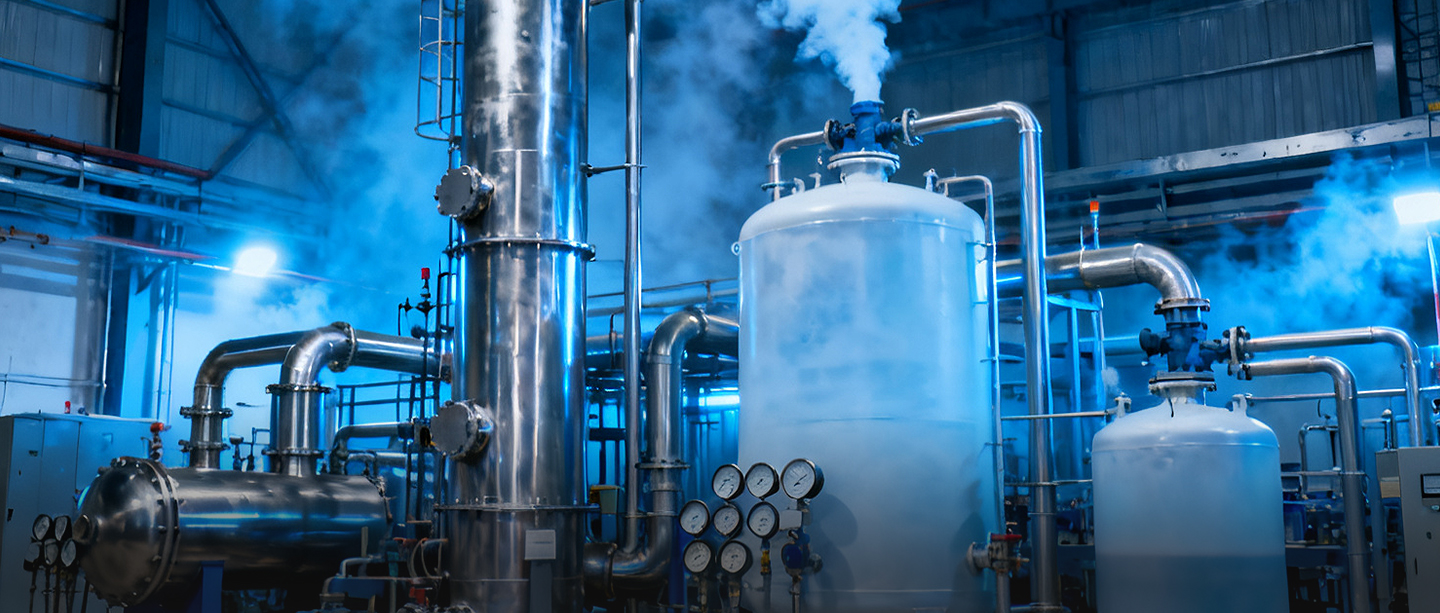
Cryo Air Separation Module
Cryogenic air separation separates gases by cooling air to extremely low temperatures (below -196°C) and utilizing the differences in boiling points between different gas components. Nitrogen (boiling point -195.8°C), oxygen (-183°C), and argon (-186°C) in the air have different boiling points; each component can be efficiently purified through fractional distillation in a distillation column.
1. Process Flow
Compression: Air is pressurized to 5-6 MPa by a multi-stage compressor to provide power for subsequent liquefaction.
Purification: Impurities such as water vapor and CO₂ are removed by molecular sieve adsorbers to avoid equipment blockage at low temperatures.
Cooling and liquefaction: Compressed air is gradually cooled to below -180℃ by the main heat exchanger and liquefied into liquid air.
Fractional distillation: Liquid air enters a distillation column (a combination of high-pressure and low-pressure columns), where nitrogen, oxygen, and argon are separated through multi-stage distillation.
2. Equipment Composition
Air compressor: Provides a high-pressure air source (0.7~1.0 MPa)
Molecular sieve adsorber: Removes impurities such as CO₂ and moisture, protecting downstream equipment.
Main heat exchanger: Enables heat exchange, recovers cold energy, and reduces energy consumption.
Expander: Uses adiabatic expansion to rapidly cool air to its liquefaction temperature.
Distillation column: A combination of high-pressure and low-pressure columns that separates nitrogen, oxygen, and argon by utilizing differences in boiling points.
Condenser-evaporator: Provides cooling circulation within the fractionation column, promoting the distillation process.
3. Application Cases
Iron and steel smelting, chemical production, medical and electronic products, wastewater treatment
4. Technical advantages and disadvantages
Advantages:
High purity: It can simultaneously separate oxygen, nitrogen, argon and rare gases.
Large-scale production: A single unit can produce thousands of tons per day and is suitable for continuous operation.
Economic efficiency: Low unit energy consumption under long-term operation (especially for large-scale applications).
Limitations:
High investment: High equipment costs, requiring specialized factory buildings and infrastructure.
Slow start-up: It takes several hours to several days from startup to stable gas production.
Maintenance is complex: Regular checks of the cryogenic equipment's sealing and cooling circulation system are required.
Cryogenic air separation, with its core advantages of 'high purity and large-scale production,' is the mainstream technology for industrial gas separation; however, a balance must be struck between investment and energy costs. Selection requires a comprehensive evaluation considering purity requirements, production scale, and operating conditions.
Contact Information
E-mail:kpt@vip.163.com
Sales Department:
International Markets:
Name: Zhang Ning
E-mail:zhangning@cnkpt.com
Telephone:+86 15122363326
WhatsApp:+86 15122363326
Skype :live:.cid.8ce260f7adff31dd
China Market:
Name: Guo Le
E-mail:guole@cnkpt.com
Telephone:+86 15122381880
After-sales service department:
Name: Liu Gang
E-mail:liugang@cnkpt.com
Telephone:+86 15022544922
Name: Han Jianping
E-mail:hanjianping@cnkpt.com
Telephone:+86 18526288340
International Engineering:
Name: Xue Xiulong
E-mail:xuexiulong@cnkpt.com
Telephone:+86 13672109867
Name: Yao Jingxuan
E-mail:yaojingxuan@cnkpt.com
Telephone:+86 13920277001
Share Us

Site Navigation
Copyright © 2025 All Rights Reserved
Tianjin Kepu Electromechanical Equipment Engineering Co., Ltd.
All rights Reserved|Technical Support:YunChuangChengda This Site Supports IPv6
Please choose online customer service to communicate


 中文
中文
 English
 SaudiArabia