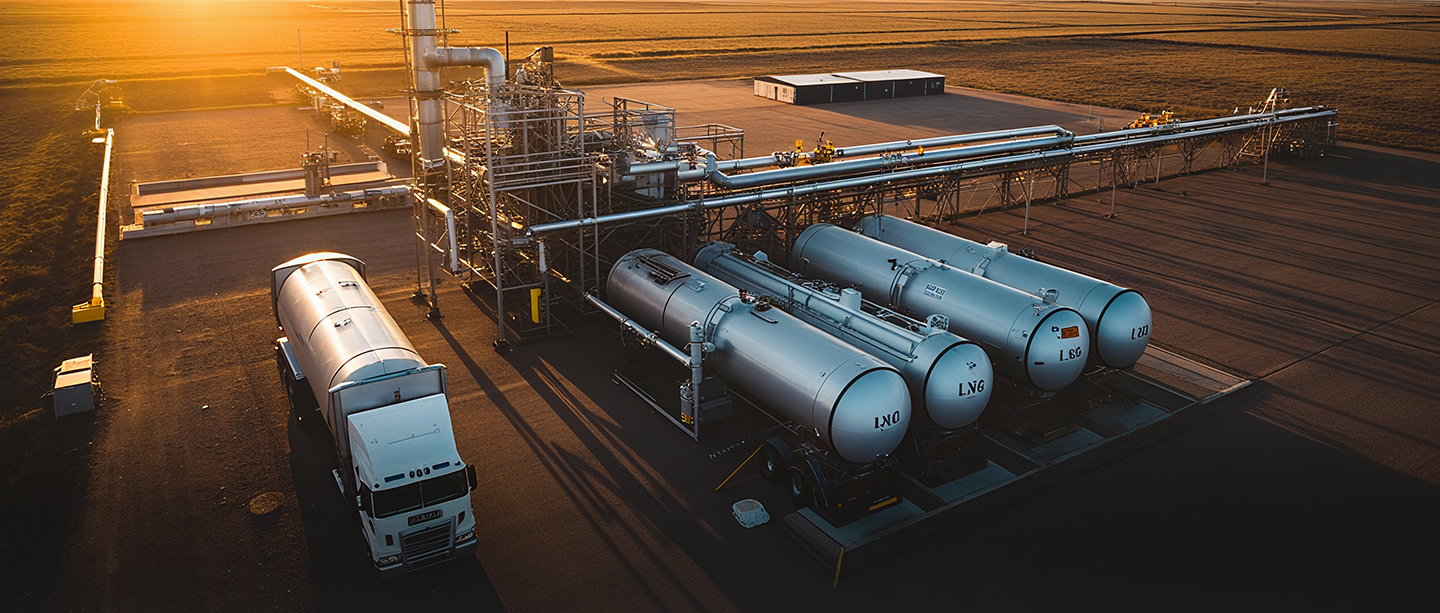
LNG Module
Main types of LNG processes:
Cascade Process
Principle: The natural gas is liquefied by using a three-stage refrigerant system consisting of propane (-42℃), ethylene (-96℃), and methane (-161℃) for progressive cooling, and by using a multi-stage heat exchanger.
Advantages: High efficiency, suitable for large-scale production (such as export terminals).
Mixed Refrigerant Liquefaction Process (MRC)
Principle: A mixed refrigerant of C1 to C5 hydrocarbons and nitrogen is used to achieve single-stage liquefaction through a fractionation tower circulation.
Advantages: Simplified equipment, reduced investment costs by 30%, suitable for small and medium-sized projects.
Expanded liquefaction process (e.g., AP-C3H8)
Principle: It utilizes the self-expansion of natural gas for refrigeration (Joule-Thomson effect), eliminating the need for external refrigerant.
Applicable scenarios: Small-scale scenarios such as associated gas treatment in oil fields.
1. Key Equipment and Technical Parameters
Molecular sieve adsorber: Removes impurities such as CO₂ and H₂O, preventing freezing and pipeline blockage at low temperatures; adsorbent lifespan: 5-8 years, regeneration temperature 200-300℃;
Main heat exchanger: Enables heat exchange between natural gas and refrigerant/cooling medium; core cooling equipment; heat exchange efficiency >95%, material must be 9% nickel steel;
Distillation column: Separates components such as methane and ethane, increasing the calorific value of LNG (typically required to be >50MJ/m³); operating pressure: 0.4-0.6MPa;
BOG compressor: Processes evaporating natural gas (BOG) from storage tanks; recovery rate must be >99%, and the daily evaporation capacity of the storage tank must be 1.2 times the daily evaporation capacity.
2. Process optimization and innovation
Cold energy recovery system
The cold energy (approximately 230 kJ/kg) generated during LNG vaporization can be used for air separation oxygen production or cold chain logistics, resulting in a 15% improvement in overall energy efficiency.
Modular design
Integrating liquefaction units onto offshore platforms reduces onshore construction costs.
Digital control
AI algorithms are used to dynamically adjust refrigerant flow, reducing energy consumption.
3. Safety and Environmental Protection Requirements
Leakage protection
The storage tank must be equipped with a double-wall structure, and the leakage detection sensitivity should be ≤100ppm methane.
Emission control
The NOx emissions from BOG treated by the combustion tower must be <50mg/m³ (EU standard).
LNG technology achieves efficient natural gas liquefaction through "multi-stage refrigeration" and "precision purification." Technology selection requires a comprehensive evaluation based on scale, feedstock composition, and cost. Future trends are towards "low-carbon" technologies (such as hydrogen-blended LNG) and "intelligent" technologies (AI-driven operation and maintenance).
Contact Information
E-mail:kpt@vip.163.com
Sales Department:
International Markets:
Name: Zhang Ning
E-mail:zhangning@cnkpt.com
Telephone:+86 15122363326
WhatsApp:+86 15122363326
Skype :live:.cid.8ce260f7adff31dd
China Market:
Name: Guo Le
E-mail:guole@cnkpt.com
Telephone:+86 15122381880
After-sales service department:
Name: Liu Gang
E-mail:liugang@cnkpt.com
Telephone:+86 15022544922
Name: Han Jianping
E-mail:hanjianping@cnkpt.com
Telephone:+86 18526288340
International Engineering:
Name: Xue Xiulong
E-mail:xuexiulong@cnkpt.com
Telephone:+86 13672109867
Name: Yao Jingxuan
E-mail:yaojingxuan@cnkpt.com
Telephone:+86 13920277001
Share Us

Site Navigation
Copyright © 2025 All Rights Reserved
Tianjin Kepu Electromechanical Equipment Engineering Co., Ltd.
All rights Reserved|Technical Support:YunChuangChengda This Site Supports IPv6
Please choose online customer service to communicate


 中文
中文
 English
 SaudiArabia